
UK packaging machinery support 01494 623015

Rotary bottle unscrambler

Rotary bottle unscrambler and compact bottle feeding options

A compact rotary route can be a sensible starting point where the line needs steadier empty-bottle feed without a large automatic unscrambling system.

Specification advice

Choose the machine route around the bottle and the line.

Compact bottle feeding for limited floor space

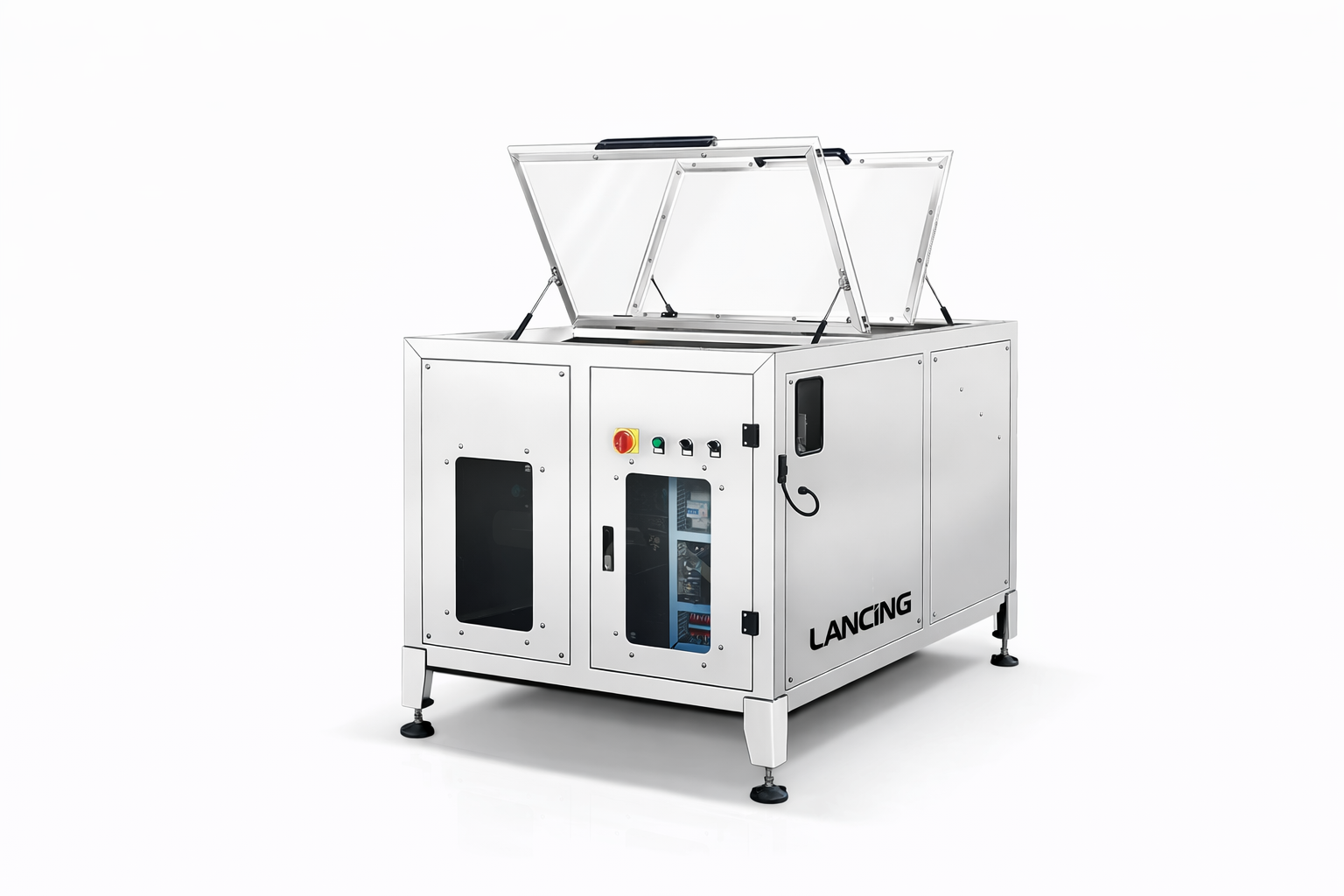
A rotary bottle unscrambler or feed table can provide controlled delivery into downstream conveyors where floor space is restricted. It is often considered for compact lines, semi-automatic systems and lower to medium output production areas.
Where it works well

This route suits stable bottles that can be handled without complex orientation control. It is useful before fillers, cappers, labellers and coding systems where the main issue is controlled accumulation and feed rather than full bottle orientation.

What to check before buying

Check the bottle base, empty weight, line height, bottle diameter, required bottles per hour, outfeed transfer and guarding. If bottles bridge, tip or jam, a different infeed route may be required.

Lancing UK support

Send bottle details and target output for a practical shortlist.

Lancing UK can review the bottle format, downstream machinery and available floor space before recommending a compact rotary bottle feeder, automatic bottle unscrambler or wider infeed solution.

Request a bottle unscrambler shortlist
Automatic bottle unscrambler machinery

Questions

Common specification questions.

Is a rotary unscrambler suitable for all bottles?

No. It works best with stable bottles that can feed reliably from a rotating disc. Unstable or awkward shapes may need a more controlled machine.

What output can a compact rotary route provide?

The LU-SP800 route is listed at 2400–3600 bottles per hour, subject to bottle type and line conditions.

LU-SP800 specification evidence

Use the compact rotary route where bottle stability and controlled delivery are proven.

The LU-SP800 uses an 800 mm rotating disc to accumulate and deliver suitable bottles. It should not be treated as a universal orientation solution: the bottle must remain stable on the disc, through the guide arrangement and at the conveyor transfer.

Published parameterReference valueWhat still needs confirmation
Capacity2400–3600 BPHSustainable feed with the actual bottle, operator loading pattern and downstream stop-start behaviour.
Turntable800 mm at 10 rpmAccumulation requirement, bottle contact pressure, available footprint and outfeed arrangement.
Suitable bottle rangeDiameter 20–100 mm; height 30–120 mmBase stability, centre of gravity, wall stiffness and whether the bottle needs orientation beyond simple single-file delivery.
Motor power, size and weight120 W; 850 × 850 × 1500 mm; 50 kgFinal mounting, electrical connection, guarding, maintenance access and conveyor interface.

View the first-party LU-SP800 machine page for the published specification source.

Stability, contact and recovery

Prove that accumulation does not create a new bottle-handling problem.

A rotary table is effective when bottles remain upright and move predictably toward the outfeed. Trial the least stable format and observe crowding, guide contact and the handover into the conveyor. Excessive back pressure can increase scuffing or tipping, so the amount and position of accumulation should be agreed around the real line.

Include a planned downstream stop, restart and controlled blocked-outfeed test. The evidence should show how the machine responds, how operators clear the condition safely and whether bottle flow recovers without repeated bridging.

Compare specialist rotary accumulation guidance

Bottle base and centre-of-gravity check

Disc loading and crowding observation

Guide contact and scuffing inspection

Outfeed gap and conveyor handover

Downstream stop and restart test

Changeover setting record

Rotary-route questions

Questions to answer before choosing a rotating-disc feeder.

Does the LU-SP800 orient every bottle shape?

No universal orientation claim should be assumed. It is a compact rotating-disc route for suitable bottles; bottle geometry and presentation needs must be checked from samples.

Does 2400–3600 BPH guarantee the same result on every line?

No. It is published reference data. Sustainable output depends on bottle stability, loading, guide settings, downstream demand and stop-start behaviour.

How much accumulation is appropriate?

Enough to support normal downstream variation without creating damaging pressure, scuffing, tipping or difficult operator access.

What is the most important bottle trial?

Run the tallest, lightest or least stable bottle expected, then test the conveyor transfer and a planned downstream stop.

When is the automatic route more suitable?

Consider the automatic route when bottle arrangement or presentation cannot be achieved reliably with a compact rotary table and guide arrangement.

Who should own the conveyor and accumulation design?

Use Packaging Conveyors UK where conveyor type, buffering and transfer layout are the primary engineering scope.

Rotary stability review

Check accumulation pressure, bottle contact and transfer under normal stops.

A rotating-disc route can be compact and effective for stable bottles, but the trial should include the way bottles accumulate during downstream stops. The decision should not be based only on an empty table or a short sequence with little bottle contact.

Trial conditionWhat to inspectEvidence to keep
Normal operator loadingHow bottles settle on the disc, whether they overlap or bridge, and whether the loading method needs constant correction.Wide video showing the loading pattern and the complete table.
Downstream stopBack pressure, bottle crowding, guide contact, scuffing risk and whether the outfeed remains controlled.Uncut stop sequence and before/after bottle inspection.
Restart after accumulationWhether the bottle stream releases evenly or surges, tips or immediately blocks the transfer.Restart video with the disc, guide transition and conveyor handover visible.
Least stable bottleCentre of gravity, base contact, wall stiffness and behaviour at the outfeed gap and guide transition.Side-view video and notes on the settings used.
Presentation-sensitive bottleWhether simple controlled delivery is sufficient or the downstream process needs a defined orientation.Recorded decision showing why the rotary route is suitable or why an automatic arrangement route is needed.

Where the downstream machine needs a defined bottle attitude rather than simple accumulation and delivery, review the automatic bottle unscrambler route. For recurring transfer faults, use the jam-reduction guide to identify the first abnormal movement.

Inspect representative bottles before and after the trial under consistent lighting. The purpose is not to invent a numerical damage limit, but to identify unacceptable marking, rubbing, deformation or label-panel contact that appears only after accumulation. Record the table loading condition and dwell pattern with the observation so any corrective guide or speed change can be retested against the same condition.

Rotary-disc trial

Prove stable accumulation without hiding bottle contact, pressure or restart behaviour.

The LU-SP800 route depends on the bottle remaining stable on the rotating disc and transferring cleanly into the outfeed. Trial evidence should therefore show the disc under normal loading, downstream backup and restart—not only free-running bottles.

Trial conditionObserveRecordDecision
Normal operator loadingHow bottles spread across the disc and approach the guide path.Loading method, approximate batch size and any hand correction.Whether the loading method can be repeated safely during production.
Downstream backupBottle contact, queue pressure, tipping and surface rubbing.Duration of backup, affected bottle area and condition after release.Whether accumulation is acceptable or needs control/guide changes.
Transfer to conveyorStability at guide entry, crossover and belt transition.Conveyor height, speed, guide width and transfer gap.Whether the compact route can supply the next machine reliably.
Stop and restartHow the queue settles and returns to stable discharge.Stop cause, operator action and any bottle that must be removed.Whether recovery is repeatable and suitable for the operating team.

Where visible-bottle finish matters, pair this trial with the scuffing and damage guide. Use the jam-reduction guide for transfer faults that occur beyond the disc.

Rotary-route questions

Questions about bottle stability, backup and usable table speed.

A rotary route is compact, but its success depends on how the real bottle behaves during circulation, discharge and downstream backup.

How do you judge whether a bottle is stable enough for a rotary route?

Judge stability with empty production-representative bottles at the real transfer height and a realistic downstream queue. Check the bottle base, centre of gravity, wall stiffness, tendency to overlap and behaviour when bottles contact guides or one another. A bottle that looks stable when placed by hand may still tip during acceleration, recirculation or back pressure.

Compare the general route characteristics in rotary table versus centrifugal-disc unscrambling, then use samples to confirm the chosen route.

What should happen when bottles back up at a rotary outfeed?

The rotary infeed should slow or stop according to the agreed downstream condition before contact pressure makes bottles unstable or damages presentation-sensitive surfaces. The retained queue should remain controlled, and the restart should return bottles to the conveyor without a sudden release. The acceptable amount of accumulation depends on bottle shape, material and the downstream process.

Define the backup signal and response using the controls guide; use Packaging Conveyors UK for conveyor-specific accumulation design.

Can a rotary table orient bottles, or does it only accumulate them?

A simple rotary table mainly accumulates and presents stable bottles to an outfeed, while a dedicated rotary unscrambling or orienting system includes tooling or geometry intended to separate and present bottles more deliberately. The machine name does not prove the function. The actual bottle, outfeed arrangement and required orientation must be checked against the supplied scope.

The working-principle guide separates accumulation, singulation and orientation so the required function is clear.

How should rotary table or disc speed be set during a bottle trial?

Start at a conservative setting, confirm stable circulation and transfer, then increase the setting only while the outfeed remains controlled and the downstream conveyor can accept the flow. Record the final setting with the bottle identity, guide positions and line condition. Maximum table speed is not the same as sustainable bottle output and should not be used alone as acceptance evidence.

Use the existing line-speed guide and the acceptance guide to define the trial record.

Rotary-route evidence

Confirm stability, bottle contact and restart behaviour before acceptance.

A compact rotary route should be assessed on sustained bottle condition and transfer reliability, not only the short-term outfeed rate.

Outfeed transfer and guides

Check conveyor height, guide position and the handover into the retained line before the footprint is fixed.

Representative sample trial

Use the least stable bottle and the expected format range to confirm whether the compact route remains credible.

Week 2 buyer questions

Questions about bottle pressure, accumulation and stop/restart behaviour.

Assess the bottle queue under normal production conditions rather than judging the rotary route from free-running bottles alone.

What is bottle back pressure in a rotary bottle feeder?

Bottle back pressure is the contact force created when bottles accumulate against each other, guides or a downstream restriction. Some contact is normal in many accumulation systems, but excessive pressure can make lightweight bottles tip, deform, climb, scuff or transfer unpredictably. The acceptable condition depends on bottle material, geometry, cosmetic requirements and downstream flow. It should be observed during normal running and planned stops with representative bottles.

How can excessive accumulation affect empty bottles?

Excessive accumulation can turn a stable feed into a compressed queue. Bottles may rub repeatedly, rotate against labels or decoration areas, lean on neighbouring containers, distort if the walls are soft or surge when the downstream restriction clears. The trial should show how the table behaves at normal operating level, near the intended maximum buffer and during a downstream stop. More accumulation is not automatically better.

What should be observed during a rotary-table stop and restart test?

Observe where bottles stop, whether pressure continues to build, whether any bottle tips or rides over another and how the outfeed clears when demand returns. The restart should release a controlled stream rather than a sudden surge that overloads the next transfer. Record the sensor or control condition that caused the stop, the duration, any manual intervention and the time or sequence needed to return to stable production.

When should a compact rotary route not be selected?

A compact rotary route may be unsuitable when the bottle requires positive orientation, cannot remain stable under normal accumulation, is damaged by repeated contact, has a shape that bridges at the outfeed or needs a sustained output that the representative trial cannot prove. It may also be wrong where the layout does not allow safe loading and access. In those cases, review a more controlled automatic route or a different infeed concept.

How should bottle surface condition be checked after rotary accumulation?

Start with clean reference bottles and agree the surfaces that are commercially sensitive. After running, stops and restart, inspect the same areas under consistent lighting for fresh marks, rubbing, deformation or debris. Separate handling marks that existed before the trial from new contact evidence. If cosmetic condition is important, retain representative before-and-after bottles or photographs and record the table level, guide setting and run condition.

Request a bottle unscrambler shortlist

Rotary-route operation

Questions about loading and handing over a rotating-disc bottle feeder.

A rotary route depends on stable bottle circulation, a repeatable loading pattern and clear limits on accumulation and operator intervention.

How should an operator load a rotary table without creating uncontrolled bottle pressure?

Use the loading pattern proven during the bottle trial and avoid adding bottles faster than the disc and outfeed can redistribute them. Watch the first point where bottles overlap, bridge or press against guides. The accepted method should state the normal replenishment pattern and the response to a downstream stop so that operators do not solve starvation by overloading the table.

What should be recorded after a rotary-route changeover?

Record the bottle format, guide positions, disc or table setting, discharge rail setup, conveyor interface, normal loading method and the result of first-bottle, stop and restart checks. If the least stable bottle requires a different loading or accumulation limit, record that separately instead of assuming one setting covers the complete family.

What access is needed to inspect and clear a rotary bottle feeder?

Operators need a clear view of the disc, guide path and discharge transfer, together with the safe access defined by the machine guarding and site risk assessment. The layout should allow cleaning, inspection and removal of trapped bottles without moving unrelated equipment or using the production conveyor as a working platform.

What evidence should production receive for the rotary route?

Provide the approved bottle matrix, trial video or observations, changeover settings, normal loading method, permitted accumulation condition, downstream stop and restart result, surface-condition check and recovery sequence. Production should be able to reproduce the accepted condition without relying on undocumented operator technique.

Request a bottle unscrambler shortlist

Specification support

Send the bottle format and line speed. Get a sensible machine shortlist.

Lancing UK can advise whether a compact rotary unscrambler, automatic bottle unscrambler or wider line-infeed package is the correct route.

Request a bottle unscrambler shortlist
Call now